
Copper Door vs Wooden Door in India: Which One Is Actually Worth It for Your Home?
Walk through any upscale residential project in Delhi, Gurugram, or South Mumbai today and you will notice a shift. The heavy teak entrance doors that defined Indian luxury homes for generations are beginning to share space with something different handcrafted copper and brass doors that carry their own weight in a different way entirely.
For homeowners in the middle of this decision, the question is real and the stakes are not trivial. A main entrance door is a twenty-year commitment at minimum. Getting the material right matters not just visually, but structurally, financially, and practically.
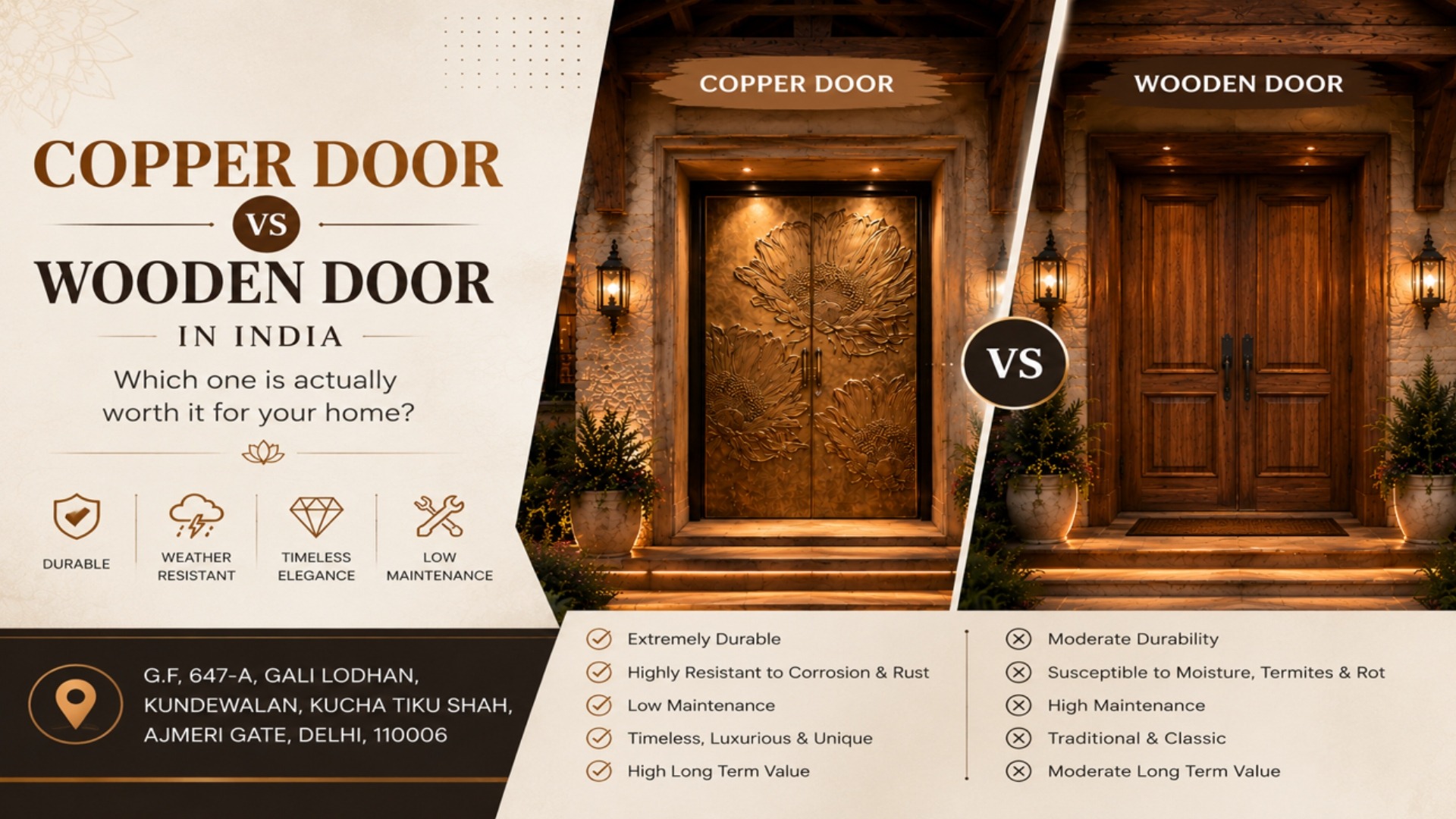
This is a direct comparison of copper doors and wooden doors across the factors that actually drive that decision in India in 2026.
How copper and wood perform in India’s climate
India does not have one climate. It has at least five. Delhi winters drop to single digits. Rajasthan summers cross 48°C. Kerala and coastal Maharashtra deal with sustained humidity above 80% for months at a stretch. Chennai’s sea air is corrosive. The Northeast has rainfall levels that European architects would find hard to believe.
Teak, rosewood, and sal wood offer durability and natural beauty, but wood requires regular maintenance to prevent warping in India’s humid climate. This is not a marginal issue. In a typical Indian monsoon cycle, exterior wooden doors absorb moisture into their grain, expand slightly, and can begin to stick, swell, or split at joints over repeated seasons. The better the wood and premium teak is genuinely excellent the slower this process. But it is never zero.
Wooden doors are prone to swelling, cracking, and warping when exposed to humidity or rain. Over time, this reduces their lifespan and increases maintenance costs.
Copper behaves differently at a chemical level. When exposed to moisture, heat, and atmospheric oxygen, copper does not weaken; it oxidises into a stable compound called cupric carbonate, which forms a tight surface layer that prevents further reaction. This is the patina that develops on copper surfaces over time. The natural patina that forms on the surface of copper not only protects the door but also increases its value over time the weathered finish, which ranges from deep bronze to greenish hues, adds character and enhances the curb appeal of your home.
In practical terms: a copper door installed at a Delhi farmhouse, a Gurugram villa, or a sea-facing Mumbai apartment will not warp in the monsoon, will not split in the summer heat, and will not require a structural intervention after a decade. It changes in appearance but it does not degrade.
Maintenance comparison over 10 years
This is where the copper door vs wooden door India comparison gets most revealing and where the initial price difference often closes faster than buyers expect.
A premium teak main door, properly maintained, requires the following over ten years:
Annual oiling or polishing to prevent surface dryness and protect the grain. Periodic repainting or re-varnishing typically every two to three years on an exterior door that takes direct sun and rain. Frame inspection and re-sealing, particularly at the base and around glass panels where moisture entry is most likely. In termite-prone regions which includes most of peninsular India periodic treatment of the door and frame is a non-negotiable additional cost.
A handcrafted copper door over the same period requires: an annual wipe-down with a soft cloth, a periodic application of paste wax or protective coating (once every two to three years for unlacquered copper), and hardware inspection and lubrication. No painting, no varnishing, no anti-termite treatment.
Copper doors require very little maintenance; the patina process naturally protects the door, reducing the need for regular upkeep. Copper doors can last for decades, if not longer, with minimal maintenance.
The actual ten-year maintenance cost for a quality wooden door in India factoring in materials, labour, and the compound effect of periodic work typically runs between ₹20,000 and ₹60,000 depending on the door size, the region, and how thoroughly the maintenance is carried out. For a copper door in the same period, the figure is closer to ₹5,000 to ₹15,000.
Cost of ownership not just purchase price
The initial price comparison is straightforward and tends to favour wood: a premium teak entrance door in India typically costs ₹50,000 to ₹1.5 lakh installed, depending on size, carving, and the quality of the craftsman. A handcrafted copper door from a specialist studio starts from approximately ₹1.5 lakh and scales with complexity and gauge.
The more useful comparison is total cost of ownership over fifteen to twenty years.
A wooden door purchased at ₹80,000 with average maintenance of ₹3,000 per year across fifteen years represents a total investment of approximately ₹1.25 lakh with the likelihood of needing replacement or major restoration at the fifteen to twenty year mark.
A copper door purchased at ₹2 lakh with minimal ongoing maintenance represents a comparable total but with a door that, at the fifteen-year mark, has developed a richer, more valuable surface and requires no structural work. While copper entry doors may have a higher upfront cost compared to other materials, their longevity makes them a smart long-term investment.
The crossover point, where the copper door’s total cost of ownership becomes equivalent to or lower than the wooden door’s, typically falls between eight and twelve years for most Indian home buyers earlier in high-humidity coastal and tropical regions where wooden door maintenance is more intensive.
Which door type suits which home
The right material is not universal it depends on the architectural context, the buyer’s priorities, and how the entrance is used.
Luxury villa or independent bungalow: Copper is the stronger choice. The entrance door of a standalone home is a statement visible from the street and expected to carry the weight of the home’s character. A handcrafted copper door with a traditional or contemporary motif delivers that in a way that teak, however beautiful, cannot quite replicate. The scale of villa entrances also suits copper’s weight and presence.
Apartment main door: Both materials are viable. If the door is sheltered from direct rain and sun as most apartment entrance doors are a premium wooden door holds up better than in exposed contexts. That said, copper door handles and copper-frame insert doors are increasingly popular in high-end apartment lobbies and penthouse entrances, where the metal’s visual weight signals quality immediately.
Farmhouse or second home: Copper wins clearly. Farmhouses in India’s semi-rural periphery Aravalli foothills, Karjat, Coonoor tend to have long periods of closure and high ambient humidity. A copper door is unaffected by months of non-use. A wooden door in the same context will dry unevenly, potentially crack, and may require restoration every time the property reopens for a season.
Heritage or haveli property: This is the one context where wood retains a genuine argument. A pre-independence haveli in Rajasthan or a colonial bungalow in Pune has a material character built on timber, stone, and lime plaster. A copper door, depending on the design, can complement this particularly if it carries traditional Indian motifs but a beautifully restored teak door with original ironwork hardware can also feel irreplaceable in that context. The decision here is as much about the building’s history as it is about materials.
Summary
Wooden doors are not a bad choice. For buyers on a tighter budget, for apartments with covered entrances, or for heritage properties where material continuity matters, a quality wooden door with regular maintenance remains entirely reasonable.
But for homeowners who are building or renovating a luxury home and are thinking across a fifteen to twenty-year horizon who want the entrance to hold its value, improve in character over time, and require minimum intervention the case for a handcrafted copper door is strong and it gets stronger the further one looks into the numbers.
The entrance door is the one part of the home every person who visits will notice and physically interact with. Investing appropriately in that single element is not excess it is proportion.
Frequently Asked Questions
Does a copper door last longer than a wooden door in India?
In most Indian climate conditions, yes. Copper does not warp, crack, swell, or attract termites. A properly maintained handcrafted copper door can last fifty years or more. Premium teak doors typically require significant restoration or replacement after fifteen to twenty-five years in exterior applications.
Is a copper door more expensive than a wooden door?
The initial purchase price of a handcrafted copper door is typically higher than a premium wooden door. However, when maintenance costs over ten to fifteen years are included, the total cost of ownership of a copper door is often comparable to or lower than that of a high-quality wooden door in India.
Can a wooden door handle India’s monsoon climate?
Quality wooden doors particularly teak can perform adequately through monsoon conditions with proper annual maintenance. However, they remain susceptible to moisture absorption and require more active upkeep than copper in high-humidity environments.
Which is better for a sea-facing home: copper or wood?
Copper is significantly better suited to coastal conditions. Wood absorbs moisture and is vulnerable to the combination of humidity, salt air, and seasonal rainfall. Copper develops a protective patina that becomes more stable over time in coastal environments.
What kind of maintenance does a copper door need in India?
An annual wipe-down and a protective wax or lacquer application every two to three years is sufficient for most Indian contexts. In coastal or very high-humidity regions, more frequent lacquer maintenance once every two to three years rather than three to five is advisable.
Aixnod manufactures bespoke handcrafted copper and brass entrance doors at its studio in Ajmeri Gate, Delhi. For consultations: +91 88519 03357 ·