
Traditional Indian Motifs on Copper Doors Lotus, Peacock, Temple Arch and Mughal Jaali: A Complete Buyer’s Guide
The front door of a home in India has never been merely functional. For centuries, the entrance has been treated as a threshold meaning a space where craft, symbolism, and identity converge before a guest even steps inside.
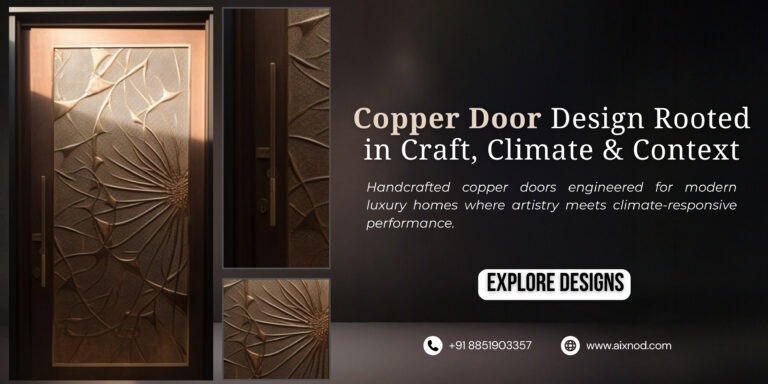
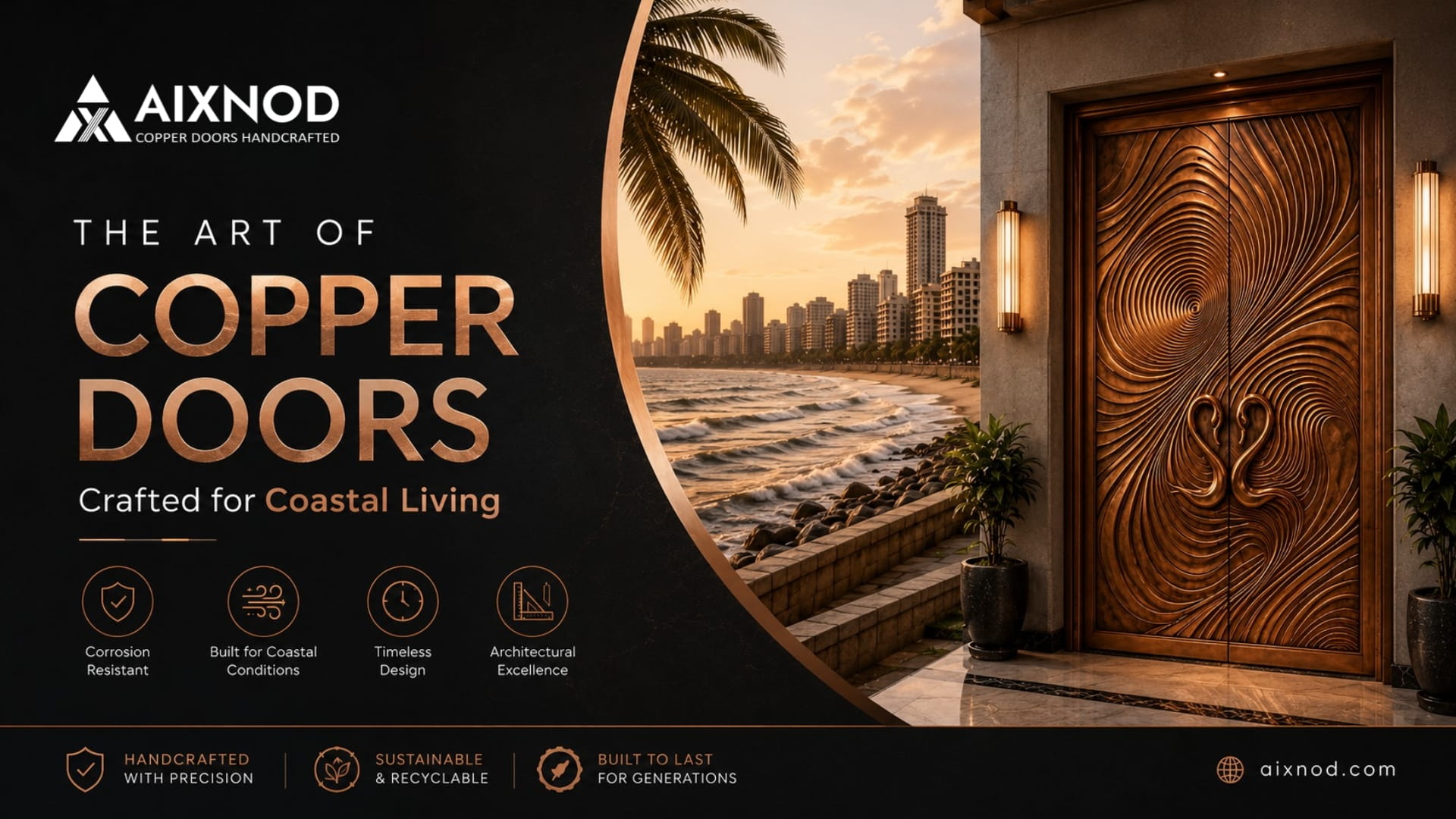
When homeowners today choose a handcrafted Indian motif copper door, they are doing something that builders of palaces, temples, and havelis have always done: using the entrance to communicate something about who lives within. This guide explains the four most requested traditional Indian motifs on copper doors, what each one means, how it translates into metalwork, and which architectural contexts suit it best.
Why copper is the natural material for Indian motif door design
Before exploring the motifs themselves, it helps to understand why copper became the material of choice for this kind of work.
Stone and wood are the traditional surfaces for Indian motif carving. Temples used stone; havelis used wood. Copper inherits the visual tradition of both while adding something neither possesses: permanence without brittleness. Copper can be worked with the same level of intricacy as stone finer, in the hands of experienced artisans and it develops a living surface over time, deepening in colour and texture in ways that carved stone and painted wood do not.
The patina that forms on a lotus copper door design or a peacock panel does not obscure the motif. It settles into the recesses of the carving, darkening the detail lines and brightening the raised surfaces, creating exactly the kind of visual depth that traditional Indian craft intends.
The lotus purity, spiritual awakening, and new beginnings
No motif appears more consistently across Indian architecture than the lotus. It is present at the base of temple pillars, on the ceilings of Mughal tombs, in the borders of Kanchipuram silk, and across the facades of some of India’s most significant sacred structures.
The symbolism is layered but consistent: the lotus grows from mud and opens toward light. In Hindu tradition it is associated with Lakshmi, Saraswati, and Brahma goddesses and gods of abundance, learning, and creation. In Buddhist and Jain iconography it represents liberation from the material world.
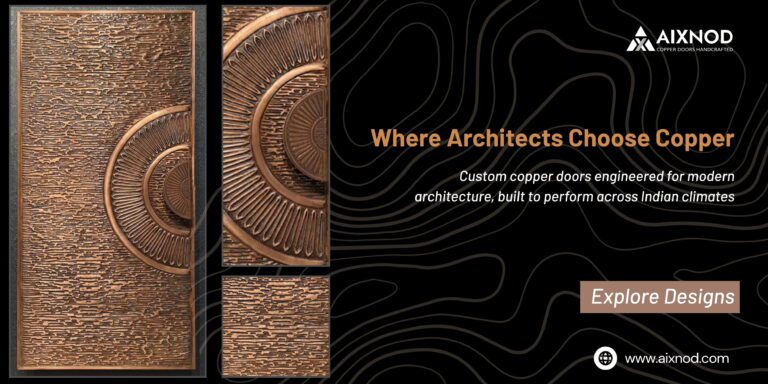
On a copper entrance door, the lotus is most commonly rendered in one of three ways. A central bloom occupies the primary panel with petals radiating outward in relief this is the most traditional presentation, closest to temple carving. A repeating border of stylised lotus buds frames the perimeter of each panel quieter, more suited to contemporary homes that want cultural reference without visual weight. The third treatment uses the lotus as a background pattern, with the blooms slightly abstracted into geometric form the effect is modern but unmistakably Indian.
Homeowners who choose a lotus motif on their copper door consistently cite both the spiritual meaning and the visual versatility. The lotus works equally well on a haveli entrance in Rajasthan, a luxury apartment in South Delhi, or a farmhouse in the Aravalli foothills.
The peacock grace, royalty, and the blessing of rain
The peacock has occupied a central place in Indian visual culture for longer than recorded history. As India’s national bird, its presence on a main entrance carries both cultural pride and specific symbolic weight: the peacock is associated with Lord Krishna, with Goddess Saraswati, and through its seasonal display with the arrival of the monsoon and the abundance it brings.
In the context of peacock door design India, the motif is almost always rendered in full, with the tail feathers fanned or partially displayed. Copper is particularly suited to this treatment because the feather’s eye, the iridescent circle at the tip of each tail feather, can be achieved through selective oxidation or inlaid material, creating a point of visual focus that reads clearly from a distance.
Peacock copper doors are especially popular for the main entrance of luxury residential villas, where the door is viewed across a driveway or approach path. The scale of the motif a peacock in full display can occupy an entire door panel demands a generous door size, typically a double door or a single door with generous width.
Architects specifying doors for hospitality projects, boutique hotels, heritage properties, private clubs frequently request peacock panels because the motif signals abundance and welcome simultaneously. It is one of the few traditional Indian motifs that carries universal recognition across regional and cultural backgrounds.
The temple arch sacred geometry at the threshold
The temple arch the curved gopuram silhouette, the pointed shikhara form, the layered torana gateway translates into copper door design as a framing device. Rather than a standalone motif like the lotus or peacock, the temple arch is typically used as the primary structural form of the door panel: the door itself is shaped to evoke the gateway of a temple, with the archway form repeated in the panelling, the relief work, or the overall outline of the door.
This is an older tradition than it might appear. Entry gates to walled homes in South India, particularly in Tamil Nadu and Kerala, have historically referenced temple architecture in their proportions and ornamental language. The modern handcrafted copper interpretation of this approach brings the same sensibility into a contemporary material.
Temple arch copper doors tend to suit traditional architectural contexts homes with strong Indian architectural character, properties adjacent to heritage structures, or interiors with significant devotional spaces. They are among the most requested designs for pooja room doors, where the arch form reinforces the sanctity of the space and the lotus or deity motifs within it.
Mughal jaali light, geometry, and the architecture of restraint
Of all the traditional Indian motifs that translate to Indian motif copper door design, the Mughal jaali is the most architecturally complex and the most technically demanding to execute well.
Jaali, meaning “net” in Arabic, is the term for a perforated latticed screen with ornamental patterns constructed through calligraphy, geometry, or natural forms. This architectural decoration is common across Indo-Islamic architecture and was used extensively by the Mughals at structures including the Taj Mahal and the Hawa Mahal.
On a copper door, jaali work is achieved either through piercing cutting the pattern through the metal sheet so that light passes through or through deep relief carving that creates the visual impression of a lattice without opening the door surface. Both approaches are used at Aixnod depending on the structural requirement of the door and the client’s intent.
Pierced jaali panels are most commonly used as inserts within a solid copper door a central section of jaali framed by solid panels rather than as the full door surface, since a fully pierced door raises questions about privacy and security. The visual effect of a pierced copper jaali panel, particularly when lit from within, is among the most striking entrances in contemporary Indian luxury architecture.
Jaali designs carry symbolic meanings beyond their visual appeal: geometric patterns represent cosmic order and mathematical precision, while floral motifs symbolise prosperity and natural harmony. Star patterns, frequently found in Mughal architecture, signify divine light and guidance.
How to choose the right motif for your home
The question buyers most frequently ask when approaching a handcrafted copper door studio is simple: which motif is right for my home?
Three factors tend to determine the answer in practice. The architectural style of the building a contemporary home in an urban setting calls for a different visual language than a traditional haveli or a heritage bungalow. The size of the door a grand double entrance can carry a peacock in full display; a single apartment door reads better with a lotus or jaali panel. And the interior character a home with strong spiritual or traditional design throughout can carry a temple arch door; a more globally influenced interior may prefer the abstracted geometry of a Mughal jaali.
Studios like Aixnod, based at Ajmeri Gate, Delhi, work through this selection process with clients collaboratively, often presenting multiple design treatments for the same motif before a final brief is agreed. The motif is never applied to the door; it is worked into the metal from the beginning of fabrication, making the design inseparable from the structure.
Frequently Asked Questions
What is the most popular Indian motif on copper doors?
The lotus and Mughal jaali are the two most consistently requested motifs. The lotus is preferred for its spiritual symbolism and visual versatility across home styles. The jaali is favoured for its architectural complexity and the play of light it creates.
Can Indian motifs be combined on a single copper door?
Yes. Many bespoke copper doors feature a primary motif a central peacock or lotus framed by a jaali-patterned border or temple arch outline. Studios like Aixnod design these combinations as part of the custom brief process.
Does the motif affect the price of a handcrafted copper door?
Directly, yes. More intricate motifs particularly full peacock displays or pierced jaali work require more artisan time. A simple lotus border on a panel door takes fewer hours than a full-surface peacock carving. The price reflects the complexity of the work.
Which motif works best for a pooja room door?
Lotus, temple arch, and Om-integrated jaali patterns are most commonly specified for pooja room doors. The lotus is the default choice for its association with purity and divine energy.
How long does it take to make a custom Indian motif copper door?
Depending on motif complexity, handcrafted copper doors with traditional Indian motifs typically take six to ten weeks from design finalisation to delivery.
Aixnod crafts bespoke handcrafted copper doors with traditional Indian motifs at its studio in Ajmeri Gate, Delhi. Contact: +91 88519 03357